

FSBO vs. Agent: Which Home Selling Method Is Right for You?
The Bottom Line Up Front
Selling a home without a realtor can save thousands in commissions, but going completely solo carries real risks most sellers underestimate.
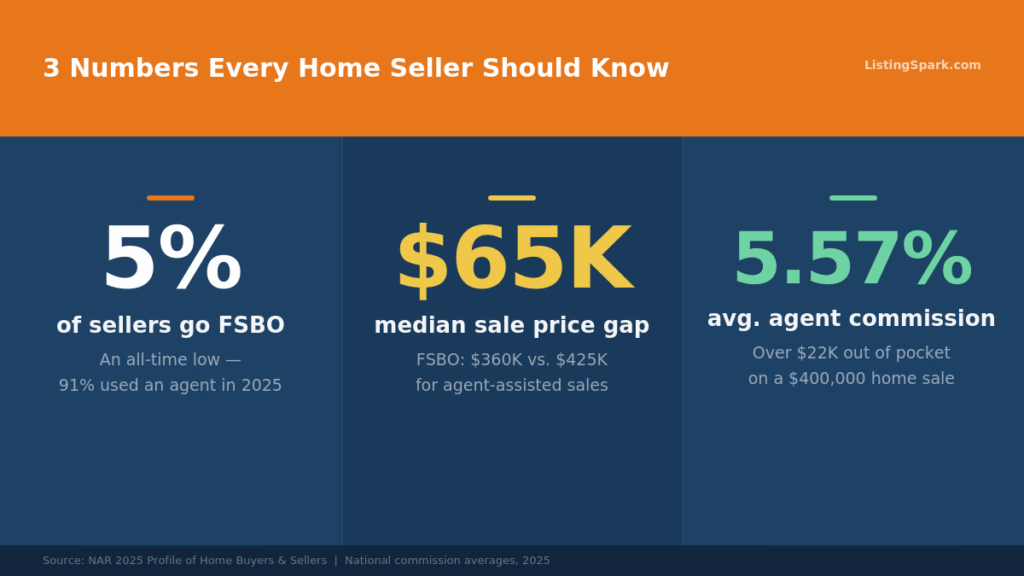
- FSBO sellers account for just 5% of home sales — an all-time low — and the median FSBO sale price is significantly lower than agent-assisted sales, according to NAR’s 2025 data
- The biggest FSBO challenges are pricing accuracy, marketing reach, and navigating complex paperwork — all areas where sellers frequently struggle without support
- Traditional agents offer expertise but cost an average of 5.57% in combined commissions, which on a $400,000 home is over $22,000 out of your pocket
- There is a third path between DIY FSBO and full-commission representation that gives sellers professional tools, MLS access, and support at a fraction of the cost
If you want to keep more of your equity without going it completely alone, explore your options before defaulting to a traditional agent.
Selling a home is one of the most significant financial decisions most people make, so it makes sense to scrutinize every cost involved. For many sellers, the debate comes down to one core question: should you attempt FSBO vs agent representation? The answer depends on your experience level, time availability, local market conditions, and how much support you need to feel confident through the process. Selling your home without an agent has become more accessible than ever, and today’s sellers have more options than ever before — which makes this decision both more complex and more interesting.
Understanding the real trade-offs in the FSBO vs agent decision helps you make a smarter, more informed choice for your specific situation.
What Does It Really Mean to Go FSBO vs. Agent?
When you sell your home as a for sale by owner transaction, you take on the responsibilities typically handled by a listing agent. That includes setting the price, arranging photography, marketing the property, scheduling and managing showings, fielding offers, negotiating terms, and navigating all the legal paperwork required to close. You control every aspect of the process, which can feel empowering, but it also means every decision and every potential mistake falls on you.
Hiring a traditional real estate agent means you’re paying for someone to manage that entire process on your behalf. The agent uses their market knowledge, their professional network, and their access to the Multiple Listing Service (MLS) to market your home to qualified buyers. They handle negotiations and paperwork, and they guide you through closing. For many sellers, especially those who have never sold a home before or who have limited time, that comprehensive support is genuinely valuable.
How Do the Two Methods Differ in Practice?
In a traditional agent-assisted sale, you sign a listing agreement, typically committing to that agent for 90 days or more. The agent sets a commission — usually around 2.7-3% of the sale price to the listing agent, with an additional buyer’s agent commission that sellers commonly still offer. For a $400,000 home, total commission costs can easily exceed $20,000.
With FSBO, you eliminate the listing agent commission entirely. However, you still need to consider the costs of marketing, photography, potential MLS access fees, and in most cases some form of buyer’s agent commission if you want to attract buyers who are working with agents. It’s a more hands-on process, but one that can be structured in different ways depending on how much support you choose to bring in.
What Are the Pros and Cons of Selling FSBO?
The appeal of for sale by owner is straightforward: keep more money from the sale. But the full picture of FSBO pros and cons is more nuanced than the commission savings alone suggest.
The clear advantages of selling without a realtor are financial control, process control, and direct communication with buyers. You set your price, your timeline, and your terms. You know your home better than anyone, and you can speak to its features authentically. If you already have a buyer lined up, such as a neighbor, family member, or someone who reached out directly, FSBO can be an especially efficient path.
The challenges are equally real. According to the National Association of Realtors’ 2025 Profile of Home Buyers and Sellers, the median FSBO sale price is $360,000, compared to $425,000 for agent-assisted sales. Some of that gap reflects the types of properties that tend to sell FSBO, but it also reflects the very real difficulties sellers face in pricing accurately, reaching buyers, and negotiating competitively without professional tools.
The Most Common FSBO Pitfalls
Many sellers underestimate how much time and effort a home sale requires. Showing management, responding to buyer inquiries, preparing disclosures, reviewing offers, and coordinating closing logistics add up to dozens of hours of work. Beyond the time commitment, there are areas where FSBO sellers frequently run into trouble:
- Pricing: Without access to comprehensive comparable sales data, many FSBO sellers either overprice (causing the home to sit on the market) or underprice (leaving equity on the table). Nearly 30% of FSBO sellers struggle specifically with pricing and end up relying on online estimators rather than professional market analyses.
- Marketing reach: Homes listed without MLS access see dramatically lower buyer traffic. The MLS is the primary source of property data that feeds Zillow, Realtor.com, and hundreds of other platforms. Without it, you’re relying almost entirely on word of mouth and organic traffic to FSBO-specific websites.
- Legal exposure: FSBO paperwork is extensive and legally consequential. Disclosure requirements, purchase agreements, and contract compliance all carry legal weight, and errors can expose sellers to significant liability. Roughly 43% of FSBO sellers report making legal mistakes during the process. For a detailed look at the documents involved, see this FSBO paperwork guide.
What Are the Pros and Cons of Hiring a Real Estate Agent?
Selling with a traditional real estate agent comes with undeniable benefits. Agents bring pricing expertise, professional marketing, negotiation skills, and an established buyer network. For sellers navigating a complex sale with multiple offers, inspection disputes, or financing contingencies, having an experienced professional in your corner has real value.
Agents also handle the paperwork. In a landscape where disclosure requirements and contract terms can sink a deal if mishandled, having someone who manages that process professionally reduces your risk considerably.
The primary drawback is cost. Real estate commissions currently average around 5.57% nationally, though this varies by market and agent. Even after the 2024 NAR settlement shifted some dynamics around how buyer’s agent fees are communicated, total seller costs remain substantial. On a $450,000 home, you could be writing a check for $25,000 or more at closing — money that comes directly out of your equity.

What the Data Shows About Agent-Assisted Sales
Agent-assisted homes do tend to sell for more, and they tend to sell faster. Part of this is MLS access and professional marketing; part of it is the negotiation skills experienced agents bring to offer review and contract execution. But the relevant question isn’t whether agents add some value — it’s whether the commission cost is proportional to that value for your specific situation.
The reality is that much of what a listing agent does — entering the property into the MLS, arranging photography, and managing the transaction — can be replicated with the right technology platform. When you divide a commission of $15,000 on a $500,000 sale by the actual hours spent on listing-side tasks, the math raises a legitimate question about whether traditional commission structures reflect the true effort involved.
How Does the 2024 NAR Settlement Change the FSBO vs. Agent Equation?
The 2024 NAR settlement introduced some of the most significant changes to real estate commission practices in decades. The key changes that affect sellers: buyer’s agent commissions can no longer be advertised through the MLS, and buyers are now required to sign written compensation agreements with their agents before touring homes.
In practice, this means sellers now have more flexibility in how they handle buyer’s agent compensation. You can choose to offer a buyer’s agent commission as a seller concession, negotiate it as part of an individual offer, or not offer it at all — though declining to pay may reduce your buyer pool in certain markets. Understanding how these commission changes affect your strategy is now an essential part of the selling process for any seller, whether FSBO or agent-represented.
For FSBO sellers specifically, the settlement opens new doors while also adding complexity. You now have more control over commission negotiations, but buyers and their agents are also navigating new expectations around compensation transparency. Having clear documentation and a well-structured listing matters more than ever in this environment.
Which Sellers Tend to Succeed Going FSBO?
Not every seller is equally suited to a FSBO transaction. Success rates vary considerably depending on a few key factors. Here’s an honest look at who tends to do well going FSBO — and who may want to think carefully before taking that path:
FSBO tends to work well for sellers who:
- Already have a buyer lined up (a friend, family member, or neighbor)
- Have prior real estate experience and understand pricing, contracts, and negotiations
- Have time to manage showings, communications, and paperwork personally
- Are selling a property in a strong seller’s market with high demand
- Have access to professional tools for pricing, MLS listing, and marketing
FSBO tends to be more challenging for sellers who:
- Are pricing a home in a competitive market without access to comprehensive comps data
- Have limited time to manage the process alongside work and family commitments
- Are unfamiliar with disclosure requirements, contracts, or closing procedures in their state
- Need to attract buyers from the widest possible pool, requiring MLS presence and broad marketing
The data tells an important story here: only about 5% of home sellers complete the process as a pure FSBO — an all-time low according to the NAR 2025 Profile — and a meaningful percentage of those who start out trying to sell without an agent ultimately bring in professional help at some point. That’s not necessarily a failure — it’s often a sign that sellers are making smart, adaptive decisions as they learn more about what the process actually requires.
Is There a Better Option Than Choosing Between Full FSBO and a Full-Commission Agent?
This is the question more sellers should be asking. The traditional framing of “FSBO vs agent” presents two extremes: go it completely alone, or pay a full commission for full representation. But the real estate industry has evolved, and there’s substantial ground between those two poles.
Full-service flat-fee listing services occupy that middle ground. These platforms give sellers MLS access, professional photography, yard signs, showing management tools, offer dashboards, and expert support — everything a traditional listing agent provides in terms of marketing and transaction mechanics — without charging a percentage of your sale price. Instead, you pay a flat fee regardless of your home’s value.
For sellers who want the reach and infrastructure of agent-assisted marketing without the commission cost, this model addresses the most significant FSBO pitfalls directly. Your home reaches buyers through the MLS and hundreds of syndicated websites. You have access to accurate pricing data. You manage offers through a structured platform rather than fielding calls on your own. And if you need guidance on a specific part of the process, support is available seven days a week without the overhead of full agency representation.
This approach also pairs well with the changes from the 2024 NAR settlement. With commission structures more flexible than ever, having control over your listing terms — including how and whether you offer buyer’s agent compensation — puts you in a stronger negotiating position from the start.
What to Look for in a Flat-Fee Listing Service
Not all flat-fee services are created equal. Some offer bare-minimum MLS entry with no photography, no support, and no marketing infrastructure. When evaluating your FSBO listing service options, look for platforms that include professional photography, showing management, a robust marketing plan, and accessible expert support. The goal is to get the exposure and tools that drive competitive offers — not just a listing that sits in a database with minimal visibility.
Also worth considering: whether the service offers access to licensed real estate professionals for specific situations — negotiations, offer review, or complex contract questions — without requiring you to commit to full representation and commission costs.
Frequently Asked Questions
Is it a good idea to sell your home without a real estate agent?
It depends on your experience, market conditions, and the tools you have available. Selling without a realtor can save thousands in commission fees, but it requires you to manage pricing, marketing, showings, negotiations, and paperwork yourself. Sellers who use a flat-fee listing service that provides MLS access and professional support often get the savings of FSBO with significantly less risk.
How much money can you save by going FSBO instead of using an agent?
The listing agent commission alone typically runs 2.5-3% of your sale price. On a $400,000 home, that’s $10,000 to $12,000 in potential savings. However, you may still choose to offer a buyer’s agent commission to attract more buyers. Your net savings depends on how you structure those costs and whether your home sells quickly and at a strong price.
Why do so many FSBO sellers end up hiring an agent anyway?
The most common reasons are pricing difficulties, low buyer traffic due to limited marketing reach, and challenges managing paperwork and negotiations. Many sellers start FSBO without realizing how much infrastructure a successful sale requires. Using a comprehensive listing service from the start addresses most of these issues without requiring full agent representation.
What changed for FSBO sellers after the 2024 NAR settlement?
The settlement eliminated the requirement for sellers to advertise buyer’s agent commissions through the MLS. Sellers now have more flexibility in how they handle buyer’s agent compensation. Buyers must also sign written agreements with their agents before touring homes. For FSBO sellers, this creates more negotiating flexibility but also adds complexity to how buyer’s agent relationships are structured and documented.
Make the Decision That Keeps the Most Money in Your Pocket
The FSBO vs agent debate doesn’t have a universal right answer. What it does have is a set of honest trade-offs that every seller should weigh before signing a listing agreement or posting a yard sign. Pure FSBO offers maximum cost control but demands significant time, expertise, and risk tolerance. Traditional agent representation offers comprehensive support but comes at a cost that, for many sellers, exceeds the value delivered.
For sellers who want the best of both — professional marketing, MLS access, pricing tools, and support, without surrendering a percentage of their sale price — ListingSpark offers a full-service flat-fee listing service built around exactly that balance. Get started today and see how much you could keep from your home sale.

Related Posts

How to Sell Your House Without a REALTOR® in Texas: The Complete 2026 Guide
The 9 steps to sell a Texas home by owner without a listing agent, with closed-sale data from 1,850 Texas sales. Pricing, MLS, disclosures, costs & forms.

Best Flat Fee MLS Services in Texas (2026): Honest Rankings & Cost Comparison
For most sellers, a supported service like ListingSpark is the best fit: you skip the listing agent’s commission but still get expert guidance on pricing, marketing, and negotiation.

Is the Cost of Selling a House Worth It in 2026?
The cost of selling a house in 2026 can easily reach 10% or more of your sale price — but it doesn’t have to. Selling a home is one of the largest financial transactions most…
