

Is the Cost of Selling a House Worth It in 2026?
The cost of selling a house in 2026 can easily reach 10% or more of your sale price — but it doesn’t have to.
- Traditional agent commissions alone now average 5%–5.5%, meaning a seller on a $400,000 home could hand over $20,000+ before a single closing fee is paid.
- Home selling costs extend well beyond commission: staging, pre-listing repairs, seller concessions, and title and escrow fees all add up fast.
- FSBO cost savings are real, but going it alone introduces risk — the right full-service approach can protect your bottom line without sacrificing support.
- Understanding exactly what you’re paying for — and why — is the first step to selling smarter in 2026.
Selling a home is one of the largest financial transactions most people will ever make, and yet the full cost of selling a house rarely gets an honest accounting until the closing table. Between commissions, closing fees, repairs, staging, and seller concessions, the total home selling cost can land anywhere from 8% to 15% of the final sale price — a significant hit that catches many sellers off guard.
The good news is that you have more options than ever before when it comes to managing how you sell your home. The 2024 NAR settlement reshuffled the commission conversation, tech-enabled listing platforms have matured, and sellers today have real data to work with. This guide breaks down every major cost you’ll face in 2026 and shows you where the real opportunities for savings exist.
What Is the True Cost of Selling a House in 2026?
Most sellers walk into the process thinking primarily about the agent’s commission. But the actual cost of selling a house is a collection of layered expenses that, taken together, can substantially reduce your net proceeds. Understanding each category gives you the leverage to question what’s negotiable and what isn’t.
According to Bankrate, sellers routinely pay between 10% and 15% of the purchase price when all costs are tallied — not just the commission. That figure covers realtor fees, closing costs, pre-listing prep work, carrying costs, and any concessions made to the buyer. On a $400,000 home, that range represents $40,000 to $60,000 in total outflows. Knowing where each dollar goes — and which ones you can claw back — is the point of this breakdown.
What Do Agent Commissions Actually Cost in 2026?
Realtor commissions remain the single largest expense for most home sellers. Despite widespread expectations that the 2024 NAR settlement would push commissions down, the data tells a different story. According to Inman, the average U.S. buyer’s agent commission reached approximately 2.42% in Q3 2025 — a steady climb back toward pre-settlement levels after an initial dip. Combined with a listing agent fee that typically runs 2.5%–3%, total realtor commission now averages 5%–5.5% nationally.
For a home priced at the median value, that translates to roughly $20,000 in realtor fees going out the door at closing. Many sellers are still choosing to offer buyer’s agent compensation to keep their home competitive, even though the NAR settlement made it optional. In slower markets, where buyers have more leverage, sellers who decline to cover this cost sometimes find their homes sitting longer or attracting fewer offers.
What Are the Closing Costs Sellers Pay?
Beyond agent fees, sellers take on a range of closing costs that vary significantly by state and county. These typically include title insurance for the buyer, escrow and settlement fees, prorated property taxes, recording fees, and transfer taxes. In most markets, seller closing costs run between 1% and 3% of the sale price. In some states — particularly those requiring real estate attorneys to oversee closings — the high end of that range can be exceeded.
Integrated title and escrow services can streamline this process and even reduce some of these fees, particularly when the title company is working in tandem with your listing platform from day one. It’s one of the areas where a well-designed home selling service can deliver meaningful savings beyond the commission line.
What Hidden Home Selling Costs Do Sellers Overlook?
The cost of selling a house extends into categories that don’t show up on a standard commission disclosure form. These are the expenses that quietly erode your proceeds and often aren’t mentioned until you’re already in the process.
Pre-Listing Repairs and Staging
Most sellers need to invest something in the property before it’s ready to list. This might mean fresh paint, landscaping cleanup, appliance upgrades, HVAC servicing, or fixing items flagged during a pre-inspection. Costs here vary widely — from a few hundred dollars for cosmetic touch-ups to tens of thousands for aging systems — but the majority of sellers spend somewhere between $2,000 and $10,000 on pre-listing preparation.
Professional staging is an additional cost that many sellers underestimate. HomeAdvisor reports that homeowners spend an average of $1,849 on staging, with most projects ranging from $832 to $2,922. For vacant properties requiring full furniture rental, that cost can climb above $5,000. Staged homes do tend to sell faster and sometimes for more money, but it’s another line item that adds to the total home selling cost equation.
Carrying Costs and Seller Concessions
Every month your home sits on the market costs money. Mortgage payments, property taxes, homeowners insurance, and utilities continue accumulating whether your home is actively being shown or not. A property that takes two to three months to close can quietly add $3,000 to $6,000 in carrying costs, depending on your mortgage and local tax rates.
Seller concessions have also become increasingly common in 2025. With inventory rising and buyers holding more negotiating power than in recent years, Bankrate notes that sellers in many markets are now expected to offer price reductions, closing cost credits, or other incentives to get deals across the finish line. In a balanced or buyer-favored market, the pressure to offer concessions is real — and it adds another 1%–2% to the total cost of selling a house.
How Does the Cost of Selling a House Break Down on a $400,000 Home?
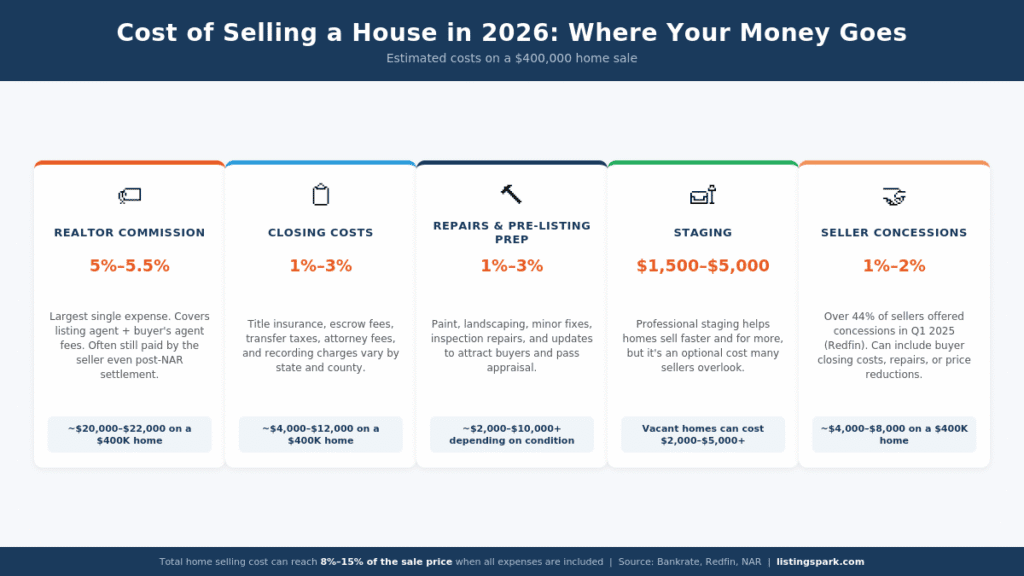
To make these numbers concrete, here’s what a typical seller can expect to pay on a $400,000 home sale in 2026. These figures use national averages and will vary by location, condition, and how you choose to sell.
- Realtor commissions (5%–5.5%): $20,000–$22,000
- Closing costs, title, and escrow (1%–3%): $4,000–$12,000
- Pre-listing repairs and updates (0.5%–2%): $2,000–$8,000
- Professional staging (optional): $1,500–$5,000
- Seller concessions (1%–2%): $4,000–$8,000
- Carrying costs (varies by timeline): $1,500–$5,000
Total estimated range: $33,000–$60,000
That’s a significant portion of your equity. For sellers who have held their home for years and built substantial equity, the hit may feel manageable. For recent buyers, move-up buyers, or real estate investors who sell frequently, these costs compound quickly — making an exploration of FSBO cost savings or alternative listing strategies a worthwhile exercise.
Does the NAR Settlement Change What You Pay to Sell?
The 2024 NAR settlement was expected to reduce what sellers pay in commissions, but the real-world impact has been more nuanced than many anticipated. The settlement eliminated the requirement for sellers to offer buyer’s agent compensation through the MLS and introduced mandatory written buyer representation agreements. In theory, buyers were now responsible for negotiating their own agent compensation — potentially freeing sellers from covering that fee.
In practice, many sellers are still offering buyer’s agent compensation because doing so keeps their homes more attractive in competitive or slow markets. The settlement created transparency and gave sellers the right to negotiate — but in markets where buyers hold leverage, walking away from a buyer’s commission offer often means fewer offers. The landscape is shifting, and understanding your local market conditions matters more than ever when evaluating this decision. Exploring how real estate terminology has evolved can help sellers get clear on the language before they negotiate.
What the settlement does offer clearly is more transparency. Buyers now enter every showing with a written agreement disclosing their agent’s fee. Sellers can review buyer offers with a clearer picture of how much of their proceeds will flow to agent compensation. For sellers willing to engage directly with this new structure, there is genuine opportunity to reduce the total home selling cost — particularly by working with a platform that puts commission control in the seller’s hands.

What Are Your Options for Reducing the Cost of Selling a House?
Understanding the full expense picture naturally leads to a central question: what can you actually do about it? There are several legitimate paths to reducing your total home selling cost, each with its own tradeoffs.
Does Selling FSBO Actually Save You Money?
Selling for sale by owner eliminates the listing agent’s commission — typically 2.5%–3% of the sale price — which is real money. On a $400,000 home, that’s up to $12,000 staying in your pocket. However, FSBO sellers take on every responsibility that an agent would normally handle: pricing strategy, marketing, MLS access, scheduling, offer management, paperwork, and negotiations. The learning curve is steep, and mistakes in pricing or contracts can be costly.
The most recent data from the National Association of Realtors shows FSBO homes sold for a median of $360,000, compared to $425,000 for agent-assisted sales — a $65,000 gap. The difference partially reflects that FSBO properties tend to skew toward lower-cost homes or sales to known buyers, but it’s a consistent reminder that FSBO cost savings don’t always translate directly to more money in your pocket. The full picture of FSBO selling in Texas and beyond shows that today’s FSBO sellers have more tools available than ever — and that the approach works best with the right infrastructure behind it.
How Do Full-Service Flat-Fee Listing Services Compare?
The most compelling alternative to both traditional agents and full DIY selling is the full-service flat-fee model. These platforms provide everything a traditional agent would offer — professional photography, MLS listing and syndication, pricing tools, offer management, support, and contract assistance — for a fixed fee rather than a commission percentage.
The financial difference is substantial. Rather than paying 5%–5.5% in commission on a $400,000 home ($20,000–$22,000), a seller using a comprehensive flat-fee platform pays a predictable, flat amount regardless of sale price. The support structure is still there — licensed professionals, 7-day-a-week access, negotiation tools — but the fee doesn’t scale with your home’s value. For real estate investors and repeat sellers who move multiple properties, this approach dramatically changes the home selling cost math.
This is precisely where the FSBO listing services landscape has evolved most meaningfully: the gap between “doing it all yourself” and “paying full commission” is now filled by technology-driven platforms that deliver professional-grade service at a fraction of the cost.
Is the Cost of Selling a House Worth It Without Full Agent Support?
The honest answer is that it depends on what you’re paying for. A traditional agent adds genuine value in certain situations — complex negotiations, first-time sellers who need guidance, or unusual properties where local expertise is critical. But for the majority of sellers, especially those who are informed, organized, and willing to use modern technology, the premium charged by full-commission agents doesn’t deliver proportionate value.
The listing agent’s role, at its core, is to get the property in front of buyers with competitive pricing and strong marketing. These are tasks that a well-equipped platform can accomplish at a fraction of the traditional cost. When you pay a 5%+ commission, a meaningful portion of that fee is covering overhead, brand recognition, and an agent’s split with their brokerage — not necessarily better outcomes for your specific sale.
Sellers who approach the cost of selling a house with clear eyes tend to find that reducing agent commission while maintaining professional marketing, pricing tools, and support delivers the best of both worlds. The key distinction is between a bare-bones MLS-only service that leaves you to figure out the rest and a comprehensive platform that replicates the full agent experience — just without the percentage-based fee.
Frequently Asked Questions
What is the average cost of selling a house in 2026? The average total home selling cost in 2026 typically ranges from 8% to 15% of the sale price, depending on agent commissions, closing costs, repairs, staging, and seller concessions. On a $400,000 home, total costs can range from $33,000 to $60,000.
Do sellers still have to pay the buyer’s agent commission after the NAR settlement? After the 2024 NAR settlement, sellers are no longer required to offer buyer’s agent compensation through the MLS. However, many sellers still choose to cover this fee to remain competitive. Buyer’s agent commissions have actually trended upward since the settlement, averaging approximately 2.42% nationally as of late 2025, according to Inman.
What is the single biggest cost when selling a house? Agent commissions are typically the largest single expense for home sellers, often representing 5%–5.5% of the sale price. On a median-priced home, this can exceed $20,000 — which is why alternatives like full-service flat-fee listing services have grown in popularity.
Can I reduce the cost of selling a house without sacrificing results? Yes. Sellers who use a full-service flat-fee listing platform can access professional photography, MLS syndication, pricing tools, offer management, and expert support at a fixed cost — rather than paying a commission that scales with the sale price. This approach consistently delivers strong results while keeping significantly more equity in the seller’s pocket.
What home selling costs are negotiable? Agent commissions, seller concessions, and some closing costs (such as title insurance in certain states) are negotiable. Staging, photography, and pre-listing repairs can often be managed strategically to control costs without compromising the quality of the listing presentation.
Make Every Dollar of Your Home Sale Count
The cost of selling a house in 2026 is significant, but it’s also more controllable than most sellers realize. With real estate commissions still averaging 5%–5.5%, closing costs adding another 1%–3%, and staging, repairs, and concessions layering on top, the total home selling cost can easily represent months or years of equity. Taking a systematic approach to where you can trim costs — without compromising your exposure or outcome — is where sellers win.
A clear-eyed look at your options shows that neither traditional full-commission agents nor bare-bones DIY listing represents the optimal path for most sellers. The smart middle ground delivers full MLS exposure, professional photography, pricing support, expert guidance, and comprehensive transaction management — at a price that reflects the actual work involved, not a percentage of your home’s value.
ListingSpark is a full-service flat-fee listing service that gives sellers everything a traditional agent provides — professional photography, MLS listing, offer management, 7-day-a-week support, and integrated title and escrow — for a flat fee that doesn’t grow with your home’s price. If you’re ready to sell smarter and keep more of what your home is worth, get started with ListingSpark today.

Related Posts

How to Sell Your House Without a REALTOR® in Texas: The Complete 2026 Guide
The 9 steps to sell a Texas home by owner without a listing agent, with closed-sale data from 1,850 Texas sales. Pricing, MLS, disclosures, costs & forms.

Best Flat Fee MLS Services in Texas (2026): Honest Rankings & Cost Comparison
For most sellers, a supported service like ListingSpark is the best fit: you skip the listing agent’s commission but still get expert guidance on pricing, marketing, and negotiation.

Selling a Home With a Mortgage: What Every Seller Needs to Know
Selling a home with a mortgage is not only possible — it’s how the vast majority of home sales work. Bottom line: Understanding how mortgage payoff works before you list puts you in control of…
