

Real Estate Listing Services: Everything You Need to Know
Home selling services have evolved, giving homeowners more control and cost-saving options than ever before.
- Flat-fee and full-service platforms now offer MLS access without traditional 5–6% agent commissions.
- The August 2024 NAR settlement has changed how buyers and sellers negotiate compensation.
- FSBO sales dropped to just 5%, signaling that professional listing support matters even when avoiding traditional agents.
- The right listing service combines technology, marketing exposure, and expert support to maximize your sale price.
If you want to sell smarter while keeping more equity, understanding your options for home selling services is the first step.
Real estate listing services encompass the range of tools, platforms, and professional support that help homeowners sell their properties. These services exist on a spectrum, from basic MLS-only listings to comprehensive platforms that handle everything from professional photography to contract negotiations. The method you choose directly impacts both your final sale price and how much money stays in your pocket.
The Multiple Listing Service remains the backbone of residential real estate transactions. According to the National Association of Realtors, 91% of home sellers used some form of agent assistance, and 88% of buyers purchased their homes through an agent or broker who relied on MLS data. This database connects sellers with the broadest possible pool of qualified buyers, which is why MLS access matters regardless of which type of listing service you ultimately select.
Home selling services have gained particular importance following the August 2024 NAR settlement, which changed commission structures nationwide. Sellers are no longer required to advertise buyer agent compensation through the MLS, creating new flexibility in how transactions are structured. This shift has made flat-fee and hybrid listing services more attractive to homeowners who want professional support without percentage-based commissions eating into their proceeds.
How Do Home Selling Services Work in Today’s Market?
The mechanics of listing services vary based on the type of provider, but they all share a common goal: getting your property in front of qualified buyers. When you engage a listing service, your property information gets entered into the local MLS database. This database then syndicates your listing to major consumer-facing websites like Zillow, Realtor.com, Trulia, and Redfin, where the vast majority of today’s homebuyers begin their search.
The MLS Syndication Process
Once your home hits the MLS, it becomes visible to thousands of real estate professionals and millions of potential buyers. The MLS allows agents and brokers within a particular market to share information about real estate listings, making it useful for both sellers seeking exposure and buyers looking for available properties. The listing includes essential details such as your asking price, property specifications, photos, and showing instructions. Buyer agents search this database constantly on behalf of their clients, making MLS exposure the single most effective marketing channel for residential real estate.
The syndication process typically happens within 24 to 48 hours of your listing going live. Your property information automatically flows to partner websites, ensuring maximum visibility without additional effort on your part. High-quality photos and compelling descriptions become especially important during this phase because first impressions often determine whether buyers schedule a showing.

How Showings and Offers Are Managed
Different home selling services handle showings and offers in different ways. Traditional agents coordinate everything personally, while flat-fee services often provide scheduling software that lets you manage appointments directly. Some platforms offer hybrid approaches where technology handles the routine tasks while human support steps in for negotiations and complex questions.
Understanding how listing services work helps you select the right level of support for your situation. First-time sellers may appreciate more hand-holding, while experienced investors often prefer maximum control over the process.
What Types of Real Estate Listing Services Exist?
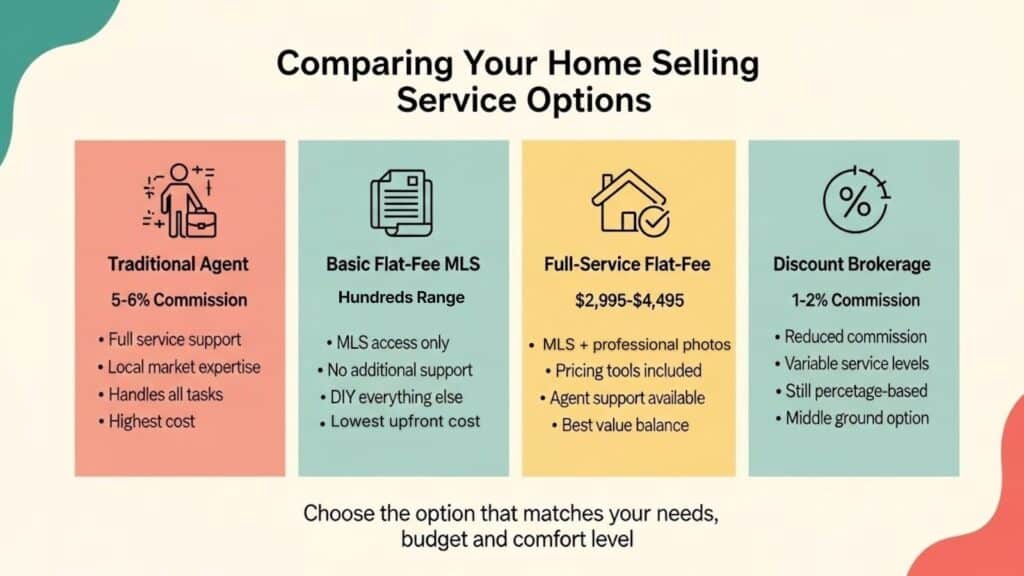
The home selling services market offers several distinct approaches, each with trade-offs between cost, convenience, and control. Knowing your options allows you to match your needs with the right type of provider.
Traditional Full-Service Agents
Traditional real estate agents charge commission-based fees, typically ranging from 5% to 6% of your home’s sale price when you factor in both the listing agent and buyer agent compensation. On a $400,000 home, this expense translates to $20,000 to $24,000 in total fees. In exchange, agents handle pricing strategy, marketing, showings, negotiations, and paperwork.
The value proposition here centers on expertise and convenience. Experienced agents understand local market dynamics and can often position your home to attract competitive offers. However, the high cost means sellers sacrifice a significant portion of their equity, especially in hot markets where homes may sell quickly regardless of agent involvement.
Basic Flat-Fee MLS Listing Services
At the opposite end of the spectrum, basic flat-fee MLS services typically charge a few hundred dollars to place your listing on the MLS. These services provide database access and syndication but little else. You handle pricing, photography, showings, negotiations, and closing coordination entirely on your own.
While the upfront savings appear attractive, this approach essentially mirrors a For Sale By Owner experience with MLS visibility added. FSBO homes sold for a median price of $360,000, compared to $425,000 for agent-assisted sales, a significant price gap that often exceeds any commission savings.
Full-Service Flat-Fee Platforms
A newer category of home selling services combines MLS access with comprehensive support for a predictable flat fee rather than a percentage commission. These platforms typically include professional photography, pricing analysis tools, marketing support, showing management, and access to licensed agents for questions and negotiations.
This approach has gained traction because it addresses the primary weaknesses of both traditional agents and basic flat-fee services. Sellers get the tools and support they need without paying percentage-based commissions that scale with home value. A seller listing a $500,000 home pays the same flat fee as someone listing a $200,000 property, creating substantial savings at higher price points.
Discount Brokerages
Discount brokerages occupy the middle ground, offering traditional agent services at reduced commission rates, typically 1% to 2% instead of the standard 3% listing fee. While cheaper than full-commission agents, these services still tie your costs to your sale price and may come with reduced attention compared to what high-commission clients receive.

What Should You Look for in a Listing Service Guide?
Choosing the right listing service requires evaluating several factors beyond just price. A comprehensive listing service guide should help you understand what each option actually delivers and whether those features match your specific needs.
MLS Access and Syndication Quality
Verify that any service you consider provides access to your local MLS, not just a national network or secondary database. The local MLS is what buyer agents actually search, so regional coverage matters. Also, confirm that your listing will syndicate to major consumer sites, as this exposure drives the majority of buyer interest.
Professional Photography and Marketing Tools
Visual presentation impacts buyer interest and perceived value. Services that include professional photography typically produce better results than those that leave photo responsibilities entirely to sellers. Look for platforms offering HD photography, virtual tours, and modern marketing materials as part of their standard package.
Understanding the cost to list on MLS and what you receive for that investment helps you compare true value rather than just headline prices.
Pricing Support and Market Analysis
Setting the right asking price from day one is critical for a successful sale. Overpricing leads to extended time on market and eventual price reductions, while underpricing leaves money on the table. The best listing services provide data-driven pricing tools or access to comparative market analysis to help you position your home competitively.
Transaction Support and Agent Access
Consider what happens when complications arise. Will you have access to a licensed professional who can answer questions about contracts, disclosures, or negotiations? Some flat-fee services leave you entirely on your own, while others include agent support as part of their package.
How Can the Right Service Provide Effective Home Sale Help?
Effective home sale help addresses the entire transaction lifecycle, from initial preparation through closing. Different sellers need varying levels of support, but certain elements prove consistently valuable across situations.
Pre-Listing Preparation Guidance
Understanding what buyers want and how to effectively present your home improves both the speed of sale and final price. Quality listing services provide guidance on staging, repairs, and presentation that help your property compete in your local market.
Pricing Strategy That Maximizes Value
Strategic pricing requires understanding both raw comparable data and current market dynamics. Nearly one-third of FSBO sellers struggle with finding an ideal price point. The right listing service helps you interpret local trends, recent sales, and competitive inventory to arrive at an asking price that attracts serious buyers while maximizing your proceeds.
Negotiation Support When It Matters
Once offers start coming in, negotiation skills directly impact your bottom line. Whether you’re evaluating multiple offers, responding to inspection findings, or navigating appraisal issues, having access to experienced guidance can mean thousands of dollars in your final proceeds.
Exploring the benefits of flat-fee MLS listing shows how modern platforms deliver these elements without traditional commission structures.
Paperwork and Compliance Management
Real estate transactions involve substantial paperwork and legal requirements. In 2025, 43% of FSBO sellers admitted to making legal mistakes within their transaction process. Disclosure forms, contracts, addenda, and closing documents all require attention to detail. Services that provide document templates, guidance, and review reduce the risk of costly errors or delays.
Why Is a Full-Service Flat-Fee Platform the Smart Choice?
The evolution of home selling services has created options that didn’t exist a decade ago. Full-service flat-fee platforms combine technology and professional expertise, delivering results that rival or exceed traditional agent outcomes at a fraction of the cost.
Maximum Savings Without Sacrificing Support
Traditional 3% listing commissions made sense when agents manually managed every aspect of the selling process. Modern technology has automated much of this work, from listing syndication to showing scheduling to offer management. Platforms that leverage this technology can deliver comprehensive support without the percentage-based pricing model.
Technology That Empowers Sellers
The best flat-fee platforms include features like AI-powered pricing tools, professional photography scheduling, electronic offer management, and integrated closing coordination. These tools give sellers visibility and control while ensuring nothing falls through the cracks.
Professional Guidance When You Need It
Unlike basic flat-fee services that leave sellers entirely on their own, full-service platforms include access to licensed real estate professionals. This support proves invaluable when complex situations arise or when sellers simply want confirmation that they’re making the right decisions.
Learning how to navigate the home-selling journey with modern listing services reveals the specific advantages these platforms offer.

Frequently Asked Questions
What is the difference between a flat-fee MLS service and a full-service flat-fee platform?
A basic flat-fee MLS service only provides MLS access and syndication. You handle everything else yourself, including photography, pricing, showings, and negotiations. A full-service flat-fee platform includes comprehensive support, such as professional photography, pricing analysis, showing management, and access to licensed agents, all for a predictable flat fee rather than percentage commission.
How much can I save by using home selling services instead of a traditional agent?
Savings depend on your home’s value and which service you select. Traditional agents typically charge 5% to 6% total commission. On a $400,000 home, that equals $20,000 to $24,000. A full-service flat-fee platform might charge $2,995 to $4,495, equating to savings of $15,000 or more, while still providing professional support and MLS access.
Do I need to offer a buyer agent commission when using a listing service?
Following the August 2024 NAR settlement, sellers are not required to offer buyer agent compensation through the MLS. However, offering competitive compensation to buyer agents can increase interest in your property since many buyers still work with agents. You have the flexibility to negotiate this compensation directly with buyers and their representatives.
Can I still get professional photography with a flat-fee listing service?
Yes, many full-service flat-fee platforms include professional photography as part of their standard package. This feature impacts buyer interest and perceived value, which is why comprehensive platforms prioritize it. Basic flat-fee MLS services typically do not include photography, leaving that responsibility entirely to the seller.
Start Your Home Sale the Modern Way
Selling your home is one of the largest financial transactions of your life. The listing service you choose impacts both your experience and your proceeds. Traditional percentage-based commissions are no longer your only option for accessing professional support and MLS exposure.
Modern home selling services combine technological efficiency with expert guidance to deliver results without the legacy commission structures that benefit agents more than sellers. Full-service flat-fee platforms have proven that sellers can keep more of their equity while still receiving the marketing exposure, professional photography, pricing analysis, and transaction support needed for a successful sale.
ListingSpark offers exactly this combination: comprehensive home selling services at a predictable flat fee. With MLS listing, professional photography, pricing tools, showing management, and access to licensed support, you get everything a traditional agent provides without the percentage-based commission. Get started with ListingSpark today and see how much you can save while still getting the professional support your home sale deserves.

Related Posts

How to Sell Your House Without a REALTOR® in Texas: The Complete 2026 Guide
The 9 steps to sell a Texas home by owner without a listing agent, with closed-sale data from 1,850 Texas sales. Pricing, MLS, disclosures, costs & forms.

Best Flat Fee MLS Services in Texas (2026): Honest Rankings & Cost Comparison
For most sellers, a supported service like ListingSpark is the best fit: you skip the listing agent’s commission but still get expert guidance on pricing, marketing, and negotiation.

Is the Cost of Selling a House Worth It in 2026?
The cost of selling a house in 2026 can easily reach 10% or more of your sale price — but it doesn’t have to. Selling a home is one of the largest financial transactions most…
