

Comparative Market Analysis: What Sellers Need to Know in 2026
Pricing your home correctly is the single most important factor in a successful sale, and a comparative market analysis is the tool that makes accurate pricing possible.
- Nearly 4 in 10 home listings required price reductions in 2025, often because sellers initially overpriced based on emotion rather than data
- Free online home valuation tools can show significant error rates for off-market properties, potentially costing sellers tens of thousands of dollars
- Professional CMAs access comprehensive MLS data that public algorithms simply cannot replicate
- Understanding how to obtain and interpret a quality CMA puts you in control of your home sale from day one
Get a professional comparative market analysis before setting your price to avoid costly mistakes and extended time on the market.
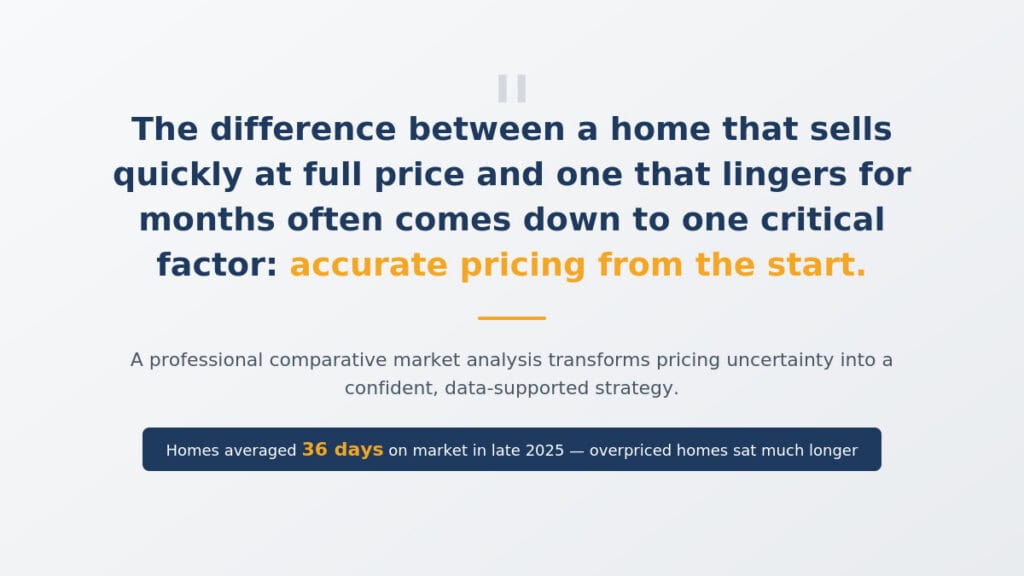
The difference between a home that sells quickly at full price and one that lingers for months often comes down to one critical factor: accurate pricing from the start. According to the National Association of Realtors, homes spent a median of 36 days on market in late 2025, but overpriced properties frequently sat much longer while accumulating carrying costs.
A comparative market analysis provides the foundation for smart home pricing by examining what similar properties in your area have actually sold for. Whether you’re a first-time seller nervous about the process or an experienced investor managing multiple properties, understanding how CMAs work empowers you to make data-driven decisions rather than relying on guesswork or outdated assumptions.
What Is a Comparative Market Analysis?
A comparative market analysis evaluates your property’s worth by examining recent sales of similar homes in your neighborhood. Real estate professionals compile this data to establish a realistic price range based on what buyers have actually paid for comparable properties, commonly called “comps.”
The process involves more than simply averaging nearby sale prices. A thorough CMA accounts for differences between your home and the comparables, adjusting values based on factors like square footage, bedroom and bathroom counts, lot size, upgrades, and overall condition. These adjustments help translate raw sales data into an accurate estimate tailored specifically to your property.
Unlike automated online estimates that rely on public records and algorithms, a professional CMA incorporates real-time MLS data that includes actual closing prices rather than just listing prices. This distinction matters significantly because many online platforms only display what sellers asked for their homes, not what buyers ultimately paid. The gap between asking and selling prices can range from thousands to tens of thousands of dollars depending on market conditions.
How Accurate Are Free Home Valuation Tools?
The convenience of instant online estimates makes them appealing starting points, but sellers should understand their limitations before relying on them for pricing decisions. Industry research indicates that automated valuation models perform reasonably well for homes currently listed on the market, with major platforms showing median error rates around 2% for active listings. However, accuracy drops substantially for off-market properties.
When your home isn’t actively listed, online home price estimators can miss the mark by significant margins. On a $400,000 home, even a 5% error represents $20,000 in potential mispricing. Setting your price too high means extended market time and eventual reductions that signal desperation to buyers. Pricing too low means leaving significant money on the table.
The accuracy gap exists because automated tools cannot physically inspect your property or account for upgrades that don’t appear in public records. A recently renovated kitchen, finished basement, or new roof adds substantial value that algorithms typically miss. Conversely, deferred maintenance or outdated features that reduce value often escape automated detection as well.
Professional free home valuation services bridge this gap by combining data analysis with human expertise. Licensed real estate professionals can evaluate your specific property characteristics, interpret local market nuances, and apply judgment that automated systems lack. This combination of data and expertise produces substantially more reliable estimates than algorithms alone.
What Does a Professional CMA Include?
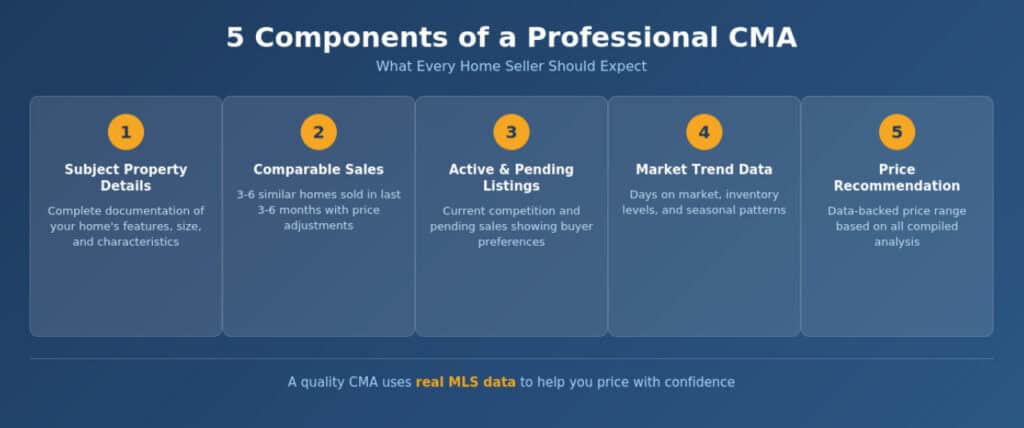
Understanding the components of a quality comparative market analysis helps you evaluate whether you’re receiving thorough analysis or a superficial estimate. A comprehensive CMA provides multiple categories of information that work together to support an accurate valuation.
Subject Property Details
The analysis begins with complete documentation of your property’s characteristics. This includes the address, square footage, lot size, year built, number of bedrooms and bathrooms, garage capacity, and special features like pools, fireplaces, or recent renovations. Accurate subject property information ensures the comparables selected truly match your home’s profile.
Comparable Sales Analysis
The heart of any CMA lies in examining recently sold properties that closely resemble yours. Quality analyses typically include three to six comparables that share similar characteristics and sold within the past three to six months. Each comp appears with its sale price, days on market, price per square foot, and relevant features. The analyst then applies adjustments to account for differences between each comp and your property.

Active and Pending Listings
Current competition matters as much as historical sales. Your CMA should show active listings that your home will compete against, along with pending sales that indicate current buyer preferences and pricing trends. This competitive analysis reveals whether the market is absorbing inventory quickly or if listings are accumulating.
Market Trend Data
Broader market context shapes how buyers perceive value. A thorough CMA includes information about average days on market, list-to-sale price ratios, inventory levels, and seasonal patterns affecting your area. According to HousingWire’s 2025 market analysis, inventory rose more than 16% year over year and nearly 4 in 10 listings saw price reductions as the market shifted toward balance. This type of contextual data helps you understand whether aggressive or conservative pricing makes more sense for your situation.
Price Recommendation
The analysis concludes with a recommended price range based on all compiled data. Rather than a single number, most professionals provide a range that accounts for uncertainty and allows flexibility based on your timeline and priorities. Sellers wanting quick sales might price at the lower end of the range, while those with more flexibility might test the upper end.
How Can Sellers Get a Free Comparative Market Analysis?
Multiple pathways exist for obtaining pricing analysis without paying out of pocket, though the quality and depth vary considerably between options. Understanding your choices helps you select the approach that best matches your needs and selling strategy.
Traditional real estate agents typically offer free CMAs as part of their listing presentation. The analysis serves as a demonstration of their market knowledge and a foundation for the pricing discussion. However, this approach involves committing to a listing appointment and potentially feeling pressure to sign a listing agreement.
Online automated tools provide instant estimates based on your address, though these carry the accuracy limitations discussed earlier. Services offering instant estimates provide convenient starting points but should never serve as your sole pricing source. Most platforms display listing prices rather than actual sale prices, creating potential for significant miscalculation.
Flat-fee real estate services increasingly offer free MLS comps and market analysis as part of their value proposition. These services provide professional-level analysis using actual MLS data while allowing sellers to maintain control over the selling process. The combination of accurate data access and flexible service options makes this approach particularly attractive for sellers comfortable managing portions of their transaction independently.
For the most reliable results, consider combining multiple sources. Start with online estimates to establish a general range, then obtain a professional CMA for sellers using MLS data for validation. Comparing results across methods helps identify potential blind spots and builds confidence in your final pricing decision.
How Does a CMA Differ From a Home Appraisal?
Sellers often confuse comparative market analyses with formal appraisals since both aim to establish property value. However, significant differences exist in methodology, purpose, and legal standing.
A CMA represents an estimate prepared by a real estate professional to inform pricing strategy. The analysis uses market data and professional judgment but does not carry legal weight or licensing requirements in most states. CMAs serve marketing and decision-making purposes rather than lending or legal functions.
Home appraisals, by contrast, require licensed appraisers who follow standardized methodologies established by regulatory bodies. Lenders require appraisals before funding mortgages to verify the property supports the loan amount. Appraisals carry legal significance and professional liability that CMAs lack.
The timing also differs. Sellers obtain CMAs before listing to set their asking price. Appraisals occur after a buyer makes an offer and applies for financing. If an appraisal comes in below the contract price, the transaction may require renegotiation or additional buyer funds to proceed.
Understanding this distinction matters because your CMA-based asking price needs to be defensible when the buyer’s lender orders an appraisal. Significantly overpricing based on unrealistic expectations often leads to appraisal shortfalls that derail transactions late in the process.
Why Do Market Conditions Matter for Your CMA in 2026?
Real estate markets constantly evolve, making the timing and context of your comparative market analysis critically important. Data from even six months ago may not accurately reflect current buyer behavior and pricing dynamics.
The 2025 market brought notable shifts that carry into 2026. Inventory increases gave buyers more options and negotiating power in many regions. NAR data shows home prices continued rising in 77% of metro areas through late 2025, but the pace of appreciation slowed considerably from pandemic-era peaks. Sellers who price based on what neighbors received two years ago often find themselves chasing the market downward.
Regional variations add another layer of complexity. Southern markets with robust new construction have experienced different dynamics than supply-constrained Northeast metros. Texas markets, for example, saw significant new inventory that shifted local pricing expectations. A CMA for sellers must account for these hyperlocal conditions rather than relying on national trends.
Mortgage rates also influence buyer purchasing power and behavior. With the average 30-year fixed rate at 6.24% in November 2025 according to NAR, buyers have become more price-sensitive and selective. Homes priced at the edge of affordability face smaller buyer pools than those positioned competitively within their market segment.
Your CMA should reflect these current realities rather than historical patterns that no longer apply. Working with professionals who actively track your local market ensures your pricing strategy accounts for conditions buyers actually face today.
Frequently Asked Questions
How often should I update my comparative market analysis?
Market conditions can shift quickly, so refreshing your CMA every 30 to 60 days makes sense if your home remains unsold. Significant changes in local inventory, interest rates, or seasonal patterns may warrant earlier updates. If you receive feedback indicating your price is too high or your showing activity drops unexpectedly, obtaining fresh comparables helps determine whether an adjustment is warranted.
Can I conduct my own comparative market analysis without professional help?
Sellers can perform basic research using public real estate websites, though access to complete MLS data remains limited. You can identify recently sold homes in your neighborhood and compare basic features, but applying accurate adjustments for differences requires experience. Starting with self-research and then validating findings with a professional CMA provides the best combination of independence and accuracy.
What makes some comparable sales better than others for pricing my home?
The strongest comps share similar characteristics with your property and sold recently within close proximity. Ideal comparables match your home’s square footage within 10-15%, have the same bedroom and bathroom count, sit in the same neighborhood or school district, and closed within the past three to six months. Properties with significant differences require larger adjustments that reduce reliability.
Why might my CMA value differ from my tax assessment?
Tax assessments and market values serve different purposes and follow different methodologies. Assessors typically evaluate properties less frequently than market conditions change, sometimes updating values only annually or every few years. Assessment methods also vary by jurisdiction and may not reflect recent renovations or current buyer preferences. Always rely on recent comparable sales rather than tax assessments for pricing decisions.
Price Your Home Right From Day One
Accurate pricing represents the foundation of every successful home sale. A well-prepared comparative market analysis transforms the uncertainty of valuation into a confident, data-supported strategy that attracts qualified buyers and maximizes your proceeds.
The FSBO path becomes significantly more achievable when you start with reliable pricing data. Sellers who understand their home’s true market position negotiate from strength and avoid the common pitfalls that extend selling timelines and reduce final sale prices.
ListingSpark provides sellers with professional comparative market analysis tools and expert pricing guidance as part of their full-service flat-fee listing platform. Their technology analyzes millions of MLS data points to help you find your optimal listing price, while their support team offers personalized assistance throughout your sale. Get started with ListingSpark to access professional-grade pricing tools and keep more money in your pocket.

Related Posts

How to Sell Your House Without a REALTOR® in Texas: The Complete 2026 Guide
The 9 steps to sell a Texas home by owner without a listing agent, with closed-sale data from 1,850 Texas sales. Pricing, MLS, disclosures, costs & forms.

Best Flat Fee MLS Services in Texas (2026): Honest Rankings & Cost Comparison
For most sellers, a supported service like ListingSpark is the best fit: you skip the listing agent’s commission but still get expert guidance on pricing, marketing, and negotiation.

Is the Cost of Selling a House Worth It in 2026?
The cost of selling a house in 2026 can easily reach 10% or more of your sale price — but it doesn’t have to. Selling a home is one of the largest financial transactions most…
