

Free Market Analysis vs Paid Appraisal: What Home Sellers Should Know
A free comparative market analysis gives home sellers a data-driven starting point for pricing, while paid appraisals provide formal valuations required by lenders.
- CMAs are typically free and prepared by real estate professionals using recent comparable sales data.
- Appraisals cost $300 to $425 and are conducted by licensed appraisers for lending purposes.
- CMAs help sellers set competitive listing prices, while appraisals verify property value for mortgage approval.
- Both tools serve different purposes in the home-selling process, and understanding when to use each can save you time and money.
Start with a free CMA to establish your pricing strategy, then expect the buyer’s lender to order a formal appraisal once you accept an offer.
Pricing your home correctly is one of the most consequential decisions you’ll make as a seller. Homes that sit on the market too long often sell for less than properly priced properties. Price too high, and your property languishes while buyers scroll past it. Price too low, and you leave thousands of dollars on the table.
Two primary tools exist to help you determine your home’s worth: the free comparative market analysis and the paid home appraisal. While both provide a home value estimate, they serve fundamentally different purposes in the selling process. Understanding how each works will help you price your property competitively and navigate the transaction with confidence.
What Is a Free Comparative Market Analysis?
A free comparative market analysis, commonly called a CMA, is a report that estimates your home’s current market value based on recent sales of similar properties in your area. Real estate professionals create CMAs by analyzing data from the Multiple Listing Service (MLS), which contains comprehensive information about listed, pending, and sold homes.
The CMA process involves identifying “comps,” which are comparable properties that share key characteristics with your home. These characteristics typically include square footage, number of bedrooms and bathrooms, lot size, age of the home, and location within the same neighborhood or school district. A thorough CMA examines properties that sold within the past three to six months to ensure the data reflects current market conditions.
What Does a CMA Include?
When a real estate professional prepares your CMA, they typically provide several key elements. You’ll see details about your subject property, including its features and condition. The report includes information on three to five comparable sales, showing their listing prices, final sale prices, and days on market. Quality CMAs also note the differences between your home and the comps, with price adjustments made for variations like an extra bathroom, updated kitchen, or larger lot.

The analysis considers current market trends too. Is inventory tight in your area? Are homes selling above or below the asking price? This context helps you understand what your home might be worth and how quickly you can expect it to sell at different price points.
How Does a Paid Appraisal Differ?
A paid home appraisal is a formal valuation conducted by a licensed, independent appraiser. Unlike a CMA, which represents an agent’s professional opinion, an appraisal follows strict guidelines established by the Uniform Standards of Professional Appraisal Practice (USPAP). The resulting report carries legal weight and is required by mortgage lenders before they’ll approve a loan.
Appraisers typically conduct an on-site inspection of your property. They measure square footage, photograph the interior and exterior, evaluate the condition of major systems, note any improvements or deficiencies, and assess overall curb appeal. After the physical inspection, the appraiser researches comparable sales and applies standardized adjustments to arrive at a fair market value.
The Cost Factor
Home appraisals come with a price tag that CMAs don’t carry. The average home appraisal costs between $300 and $425, though prices vary by location and property type. In some metropolitan areas or for complex properties, fees can reach $500 or more. The average hovers around $357 for a standard single-family home.
This cost typically falls on the buyer as part of their closing costs since lenders require appraisals to verify that the loan amount doesn’t exceed the property’s value. However, some sellers opt for pre-listing appraisals in specific situations, which we’ll discuss later.

CMA vs Appraisal: What Are the Key Differences at a Glance?
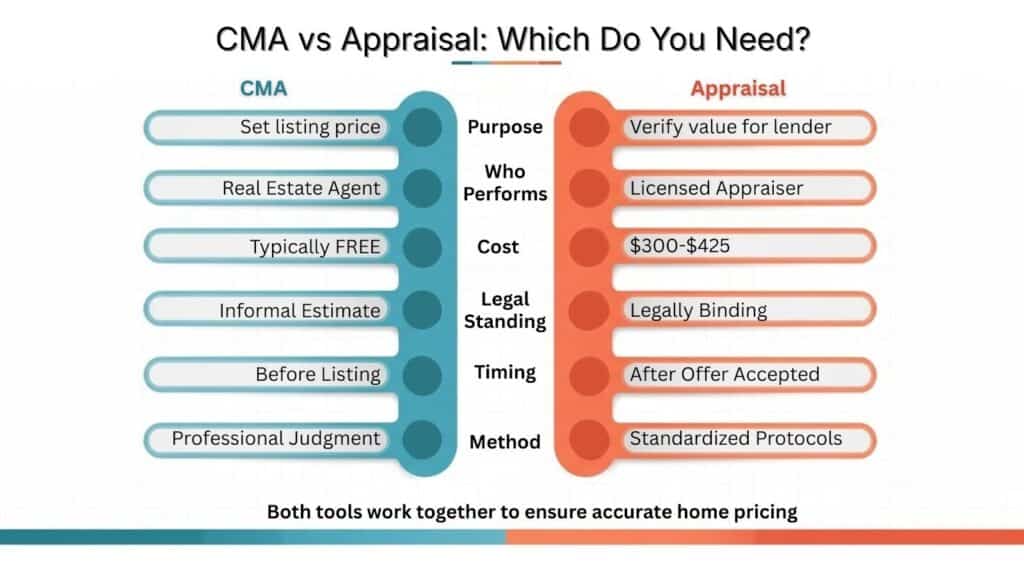
Understanding when to rely on a CMA vs appraisal becomes clearer when you examine their core differences. Here’s how these two home price tools compare across several important factors:
- Purpose: A CMA helps establish a competitive listing price before you go to market. An appraisal verifies property value for lending decisions after you’ve accepted an offer.
- Who Performs It: Real estate agents or brokers prepare CMAs using their market expertise and MLS access. Licensed appraisers with specific state credentials conduct formal appraisals.
- Cost: CMAs are typically free when you work with a real estate professional or through flat-fee services. Appraisal costs depend on your location and property type.
- Legal Standing: CMAs are informal estimates used for pricing strategy. Appraisals are legally binding documents that lenders require for mortgage approval.
- Timing: Sellers obtain CMAs at the beginning of the selling process to set their asking price. Appraisals occur after a buyer makes an offer and applies for financing.
- Methodology: Both use comparable sales, but appraisers follow standardized protocols with formal adjustments, while CMAs allow more flexibility in professional judgment.
How Accurate Is a Free Comparative Market Analysis?
The accuracy of a free comparative market analysis depends largely on the quality of the comparable properties selected and the expertise of the person preparing it. When performed by an experienced professional who knows your local market intimately, a CMA can provide a remarkably accurate estimate of your home’s potential selling price.
CMAs generally prove more accurate than automated online estimators. Popular home value tools often have higher error margins, sometimes missing the mark by 7% or more for homes not actively listed for sale. For a home worth $400,000, that could mean an estimate off by $28,000 or more. These algorithms can’t see inside your home or account for recent renovations, condition issues, or hyperlocal factors that impact value.
Why Human Expertise Matters
A real estate professional doing your CMA can physically inspect your property, account for that new kitchen you installed, recognize that your lot backs to a busy street, and understand that homes in your particular subdivision command a premium. These nuances escape online algorithms but dramatically affect what buyers will pay.
The key limitation of any CMA is that it provides a home value estimate, not a guarantee. Market conditions change, and the actual sale price depends on buyer demand, your home’s presentation, and negotiation dynamics. Still, for understanding your property’s value before listing, a well-prepared CMA gives you the data-driven foundation you need.
If you’re ready to understand your home’s market position, a free comparative market analysis can provide the insights you need to price competitively and attract serious buyers.
Why Is a Free CMA Valuable for Home Sellers?
The value of a free comparative market analysis extends far beyond simply putting a number on your property. For sellers, the CMA serves as a strategic tool that shapes your entire approach to the market.
First, there’s the obvious financial benefit. Getting professional market analysis at no cost allows you to make informed decisions without an upfront investment. When you’re already facing the expenses associated with selling a home, avoiding a $350 appraisal fee for initial pricing guidance keeps more money in your pocket.
Strategic Pricing Insights
Beyond the cost savings, a CMA provides context that raw numbers can’t capture. You’ll learn how long similar homes sat on the market before selling. You’ll discover whether homes in your area tend to sell above, below, or at their asking prices. This intelligence helps you avoid the pricing mistakes that cause listings to stagnate.
The CMA also reveals how your home stacks up against the competition. Perhaps your property has features that justify a premium price. Maybe there are condition issues you should address before listing or factor into your pricing strategy. Understanding where you stand relative to active and recently sold listings helps you position your home effectively.
For sellers exploring the FSBO route or working with flat-fee services, a CMA provides the professional-grade market intelligence that traditional agents offer. This levels the playing field and ensures you’re making data-driven decisions about one of your largest financial assets.
When Should You Get a Paid Appraisal Instead?
While CMAs effectively handle most sellers’ pricing needs, certain situations call for a formal paid appraisal before listing. Understanding when this additional investment makes sense can save you complications down the road.
Unique or Hard-to-Value Properties
If your home has unusual features that make finding comparable sales difficult, a professional appraisal provides a more reliable valuation. Consider properties with extensive custom construction, historic homes with period-specific details, estates with significant acreage, or homes with income-producing elements like guest houses or commercial space. When the MLS doesn’t contain truly comparable sales, an appraiser’s expertise in making appropriate adjustments becomes essential.
Potential Appraisal Concerns
Some sellers order pre-listing appraisals when they anticipate the eventual lender-ordered appraisal might come in low. This scenario often arises when the market has shifted, when comps are scarce, or when you’ve made substantial improvements that might not be fully captured in a CMA. Having your own appraisal provides ammunition for negotiations if the buyer’s appraisal disappoints.
Estate or Divorce Situations
When multiple parties need to agree on a property’s value for legal or financial reasons, the objectivity of a licensed appraisal carries weight that a CMA can’t match. For estate settlements or divorce proceedings, the formal documentation and standardized methodology of an appraisal often become necessary.
That said, a buyer’s lender will still require their own appraisal regardless of any pre-listing appraisal you’ve obtained. The two appraisals may produce different values, so a pre-listing appraisal doesn’t guarantee the deal will proceed smoothly.
Which Home Price Tool Should You Choose?
The choice between a CMA and an appraisal isn’t really either/or for most sellers. These tools serve different purposes at different stages of your transaction. Understanding how to use each one strategically puts you in control.
Start your selling journey with a free comparative market analysis. This gives you the market intelligence needed to set a competitive asking price, understand buyer expectations in your area, and develop your overall pricing strategy. The CMA should be your first step because it costs nothing and provides actionable insights immediately.
Making the Right Decision for Your Situation
If your property presents valuation challenges, consider adding a pre-listing appraisal to your toolkit. This extra investment provides additional confidence in your pricing and documentation that can support negotiations later. However, for the majority of standard residential properties with adequate comparable sales available, a quality CMA provides sufficient guidance.
Once you accept an offer from a buyer using financing, expect their lender to order an appraisal. This isn’t optional, and you’ll have limited control over the outcome. However, sellers who priced their home appropriately using solid CMA data rarely face appraisal issues.

The most important factor isn’t which tool you use but rather the quality of the analysis and the expertise behind it. Whether you’re getting a CMA from a tech-powered platform or a formal appraisal from a licensed professional, working with experienced pros who understand your specific market ensures you receive accurate, actionable information.
Frequently Asked Questions
How can I get a free CMA for my home? You can obtain a free comparative market analysis by contacting a local real estate agent, working with a flat-fee MLS service, or using technology-powered selling platforms that provide market analysis as part of their offerings. Many real estate professionals offer CMAs at no charge as a way to demonstrate their expertise and earn your business.
Can I use an online home value estimator instead of a CMA? Online estimators provide a quick ballpark figure but lack the accuracy of a professional CMA. These tools can have higher error margins because they can’t account for your home’s condition, recent upgrades, or hyperlocal market factors. They work best as a very preliminary starting point rather than a pricing foundation.
Will the appraisal value always match my listing price? Not necessarily. Appraisers conduct independent valuations using standardized methods, and their conclusions may differ from your asking price or even from a prior CMA. If an appraisal comes in lower than the contract price, you may need to renegotiate with the buyer, or the deal could fall through if the buyer can’t cover the difference.
Do I need both a CMA and an appraisal to sell my home? Most sellers need a CMA for pricing strategy but don’t need to pay for their own appraisal. The buyer’s lender will order and pay for an appraisal as part of the mortgage process. Pre-listing appraisals are optional and typically only recommended for unique properties or situations where you anticipate valuation challenges.
Take Control of Your Home Pricing Strategy
Understanding the difference between a free comparative market analysis and a paid appraisal empowers you to make smart decisions throughout your home sale. The CMA gives you the strategic foundation for pricing, while the appraisal provides the formal verification lenders require. Together, they ensure your property enters the market at the right price and closes without financing hiccups.
ListingSpark offers free market data and pricing insights as part of our comprehensive home-selling platform. Our technology analyzes thousands of MLS data points to help you understand your home’s value and price it competitively. Whether you’re selling your first home or your fiftieth, getting accurate market intelligence is the essential first step. Get started with ListingSpark today to access the pricing tools that make selling smarter and more affordable.

Related Posts

Best Flat Fee MLS Services in Texas (2026): Honest Rankings & Cost Comparison
For most sellers, a supported service like ListingSpark is the best fit: you skip the listing agent’s commission but still get expert guidance on pricing, marketing, and negotiation.

Is the Cost of Selling a House Worth It in 2026?
The cost of selling a house in 2026 can easily reach 10% or more of your sale price — but it doesn’t have to. Selling a home is one of the largest financial transactions most…

Selling a Home With a Mortgage: What Every Seller Needs to Know
Selling a home with a mortgage is not only possible — it’s how the vast majority of home sales work. Bottom line: Understanding how mortgage payoff works before you list puts you in control of…
